Is It Change We Resist Or something else?
Why do we resist change, even when we know it could benefit us?
A new tool, technology, system or way of working may promise to make us faster, smarter or more effective, yet our first response can still be hesitation. Often, it’s not the innovation itself we resist. It’s the uncertainty that comes with it. Will I understand it? Can I use it? Will it make my role harder? What if I get it wrong? And what does this mean for me?
For leaders, that changes the question from “Why are they resisting?” to “What do they need to confidently move from where they are to what comes next?”
Perhaps the better question is: What is stopping us from moving forward?
Resistance Is Information
When someone isn’t adopting a new system, process or technology, we often focus on the behaviour we can see:
They’re negative.
They’re resisting.
They won’t use it.
They’re stuck in the old way.
But behaviour is only the surface. Underneath it may be a very different story:
“I don’t understand why we’re doing this.”
“I don’t think this will make anything better.”
“What’s in it for me?”
“I’m worried I won’t be able to use it.”
“Nobody has shown me how.”
“I’ve tried, but I can’t get it right.”
“The old way is still easier.”
Each statement represents a different barrier. And each barrier requires a different response.
That is where change management is required and ADKAR® becomes particularly useful.
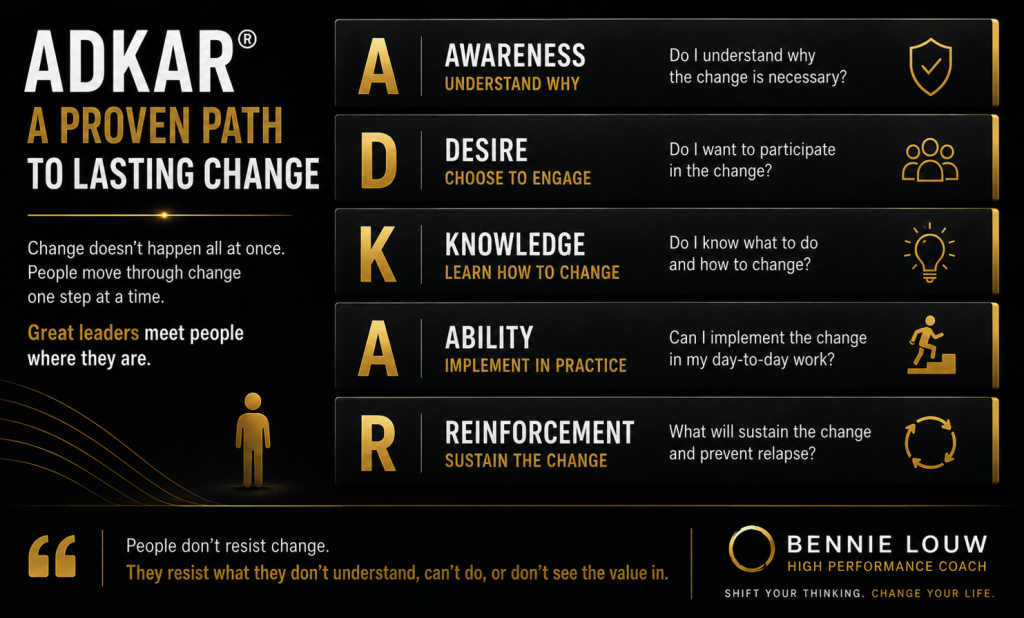
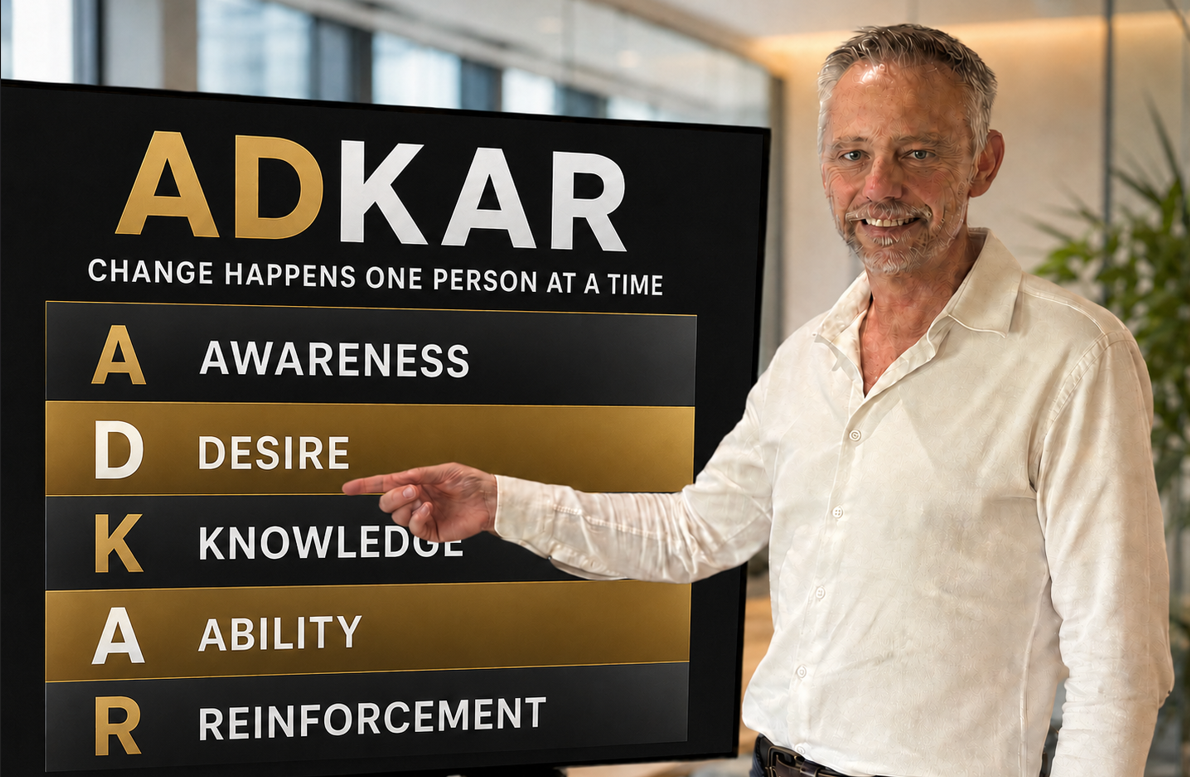
ADKAR® is a practical change framework that helps individuals, teams and organisations successfully navigate change.
It focuses on five essential stages:
Awareness of why the change is needed.
Desire to support and participate in it.
Knowledge of what needs to change and how.
Ability to put the new behaviours, tools or processes into practice.
Reinforcement to make the change stick.
Its real value is helping leaders identify where individuals or teams are getting stuck, uncover the barriers or limiting beliefs holding them back, and ask the right questions to move people from resistance and uncertainty to adoption, capability and sustainable performance.
The important leadership question becomes: Where is this person getting stuck?
Because the first stage that has not been achieved becomes the barrier point.
And pushing harder further down the change journey rarely solves a barrier that exists earlier in it.
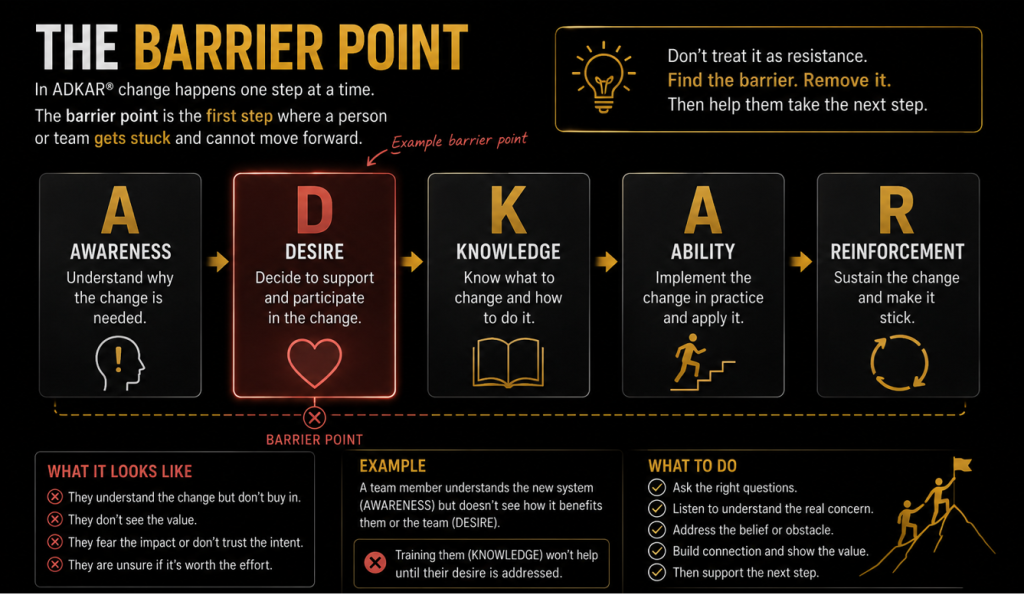
In ADKAR®, the barrier point is the first stage where an individual or team is unable to move forward with a change. For example, someone may understand why the change is needed (Awareness) but not believe it is worthwhile or beneficial (Desire). In that case, providing more training (Knowledge) will probably not solve the problem because the real barrier occurs earlier. Identifying the barrier point helps leaders stop treating every challenge as “resistance” and instead ask: Where are they stuck, what belief or concern is holding them there, and what do they need to move forward? Address the barrier first, and the next stage of change becomes possible.
Find the Barrier Point
If the Barrier Is AWARENESS
The limiting belief might sound like: “I don’t see why we need this.”
Don’t immediately send the person for more training. Training answers how. Their barrier is still why.
Ask:
What doesn’t make sense about this change?
What problem do you believe we’re trying to solve?
What happens if we continue doing things the way we do now?
What information would help you understand why this matters?
The goal is not to force agreement. It is to create understanding.
If the Barrier Is DESIRE
They understand the change, but something is stopping them from wanting to engage.
The limiting belief may be: “I understand why the organisation wants this, but I don’t see why I should.” This is where leaders need curiosity rather than persuasion.
Ask:
What concerns you most about this change?
What do you believe you might lose?
How do you think this will affect your role?
What would make this change worthwhile for you?
What would need to be true for you to give this a genuine chance?
Sometimes resistance is protecting something important: competence, status, certainty, control, relationships or identity. Understand that first.
If the Barrier Is KNOWLEDGE
The person may be willing but thinking: “I want to do this. I just don’t know how.” Now the conversation changes.
Ask:
What do you need to know that you don’t know yet?
Which part of the new process is unclear?
What training, demonstration or information would help?
Who could help you learn this faster?
This is where training becomes valuable. But training only works when lack of knowledge is actually the barrier.
If the Barrier Is ABILITY
This distinction is critical. Knowing how to do something does not mean you can do it confidently under real conditions.
Someone may understand the new technology perfectly during training and struggle when they have to use it with a client, under pressure or without support.
Their limiting belief becomes: “I know what I’m supposed to do. I’m just not confident that I can do it.”
Ask:
What happens when you try?
Where specifically do you get stuck?
What would you need to practise?
What support or feedback would help?
What would make you feel confident enough to try again?
Ability develops through practice, coaching, feedback and experience.
If the Barrier Is REINFORCEMENT
Sometimes the change worked initially, and then people went back to the old way.
The limiting belief might be: “Why should I keep doing this when the old way still works?”
Ask:
What is pulling you back toward the old behaviour?
Are our systems supporting the new way or rewarding the old way?
What progress are we recognising?
Are leaders modelling the behaviour we’re asking from others?
What would make the new behaviour easier to sustain?
Change becomes sustainable when the environment reinforces it.
Challenge the Belief, Not the Person
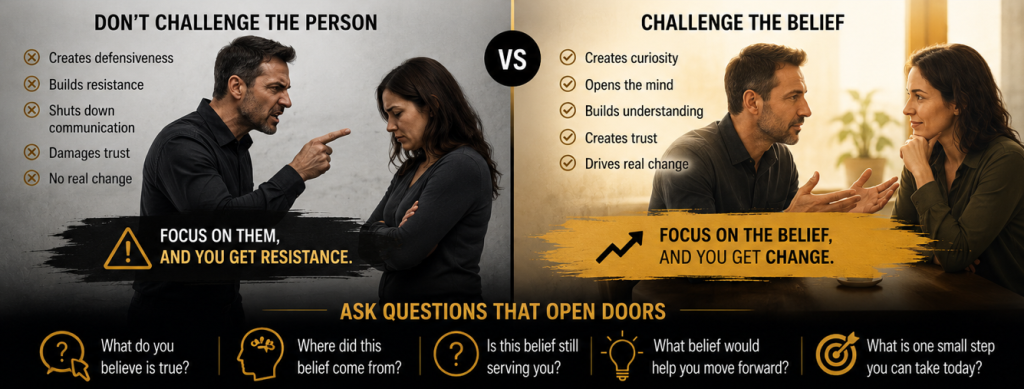
There is an important distinction here.
If someone says: “This technology is going to make my job more difficult.”
Arguing: “No, it won’t.” rarely changes the belief.
Explore it.
What makes you believe that?
What specifically are you expecting to become more difficult?
What evidence supports that expectation?
What might you be assuming that we haven’t tested yet?
What would have to happen for you to see this differently?
A limiting belief does not always need to be confronted. Sometimes it needs to be examined.
That is a very different conversation.
Don’t Push the Change. Find the Gap.
When adoption is slow, leaders naturally want to increase communication, training or pressure. Sometimes that is exactly what is required. Sometimes it isn’t.
Before deciding on the intervention, identify the barrier:
Do they understand WHY? → Awareness
Do they WANT to? → Desire
Do they know HOW? → Knowledge
Can they DO it? → Ability
Will they KEEP doing it? → Reinforcement
Find the first “No.” That is where the conversation should begin.
From Resistance to Readiness
People don’t always resist the new tool, technology or innovation itself. They may be responding to what it represents: uncertainty, loss of competence, increased expectations, reduced control or fear of getting it wrong.
The leader who sees only resistance may push harder. The leader who sees the barrier asks better questions.
And sometimes one good question can move someone further than another presentation explaining why they need to change.
Don’t ask only, “Why are they resisting?”
Ask, “Where are they stuck — and what do they need to move forward?”
That is where change becomes personal, and ultimately, organisations don’t change until people do.
Bennie Louw
Prosci® Certified Change Practitioner