Psychological Safety: The Foundation of High-Performing Teams
Do I feel safe enough to speak, ask questions and express an opinion?
High-performing teams are not teams without disagreement.
They are not teams where everybody gets along all the time, nobody makes mistakes, and difficult conversations are avoided.
In fact, the opposite is often true.
The strongest teams are able to question, challenge, disagree, admit mistakes and have uncomfortable conversations, without those moments destroying trust.
Psychological safety doesn’t mean making people comfortable.
It means making it safe enough for people to contribute honestly to performance.
That requires something increasingly important in modern organisations:
Psychological safety.
But psychological safety is often misunderstood. It does not mean making people comfortable. It means creating an environment where people feel safe enough to contribute honestly to performance.
Safety and High Performance Are Not Opposites
When leaders first hear the term psychological safety, there can be a temptation to associate it with being soft.
No criticism. No conflict. No pressure.
Everybody must feel comfortable.
That is not psychological safety.
A psychologically safe environment can still have high expectations, accountability, difficult feedback and demanding performance standards.
The difference is what happens when someone says:
“I don’t agree.” or “I made a mistake.” or “I don’t understand.”
Or perhaps the most important: “I think we’re making the wrong decision.”
What happens next tells you a great deal about the culture of that team.
The Four Levels of Psychological Safety
The model illustrated here provides a useful way of thinking about how psychological safety develops.
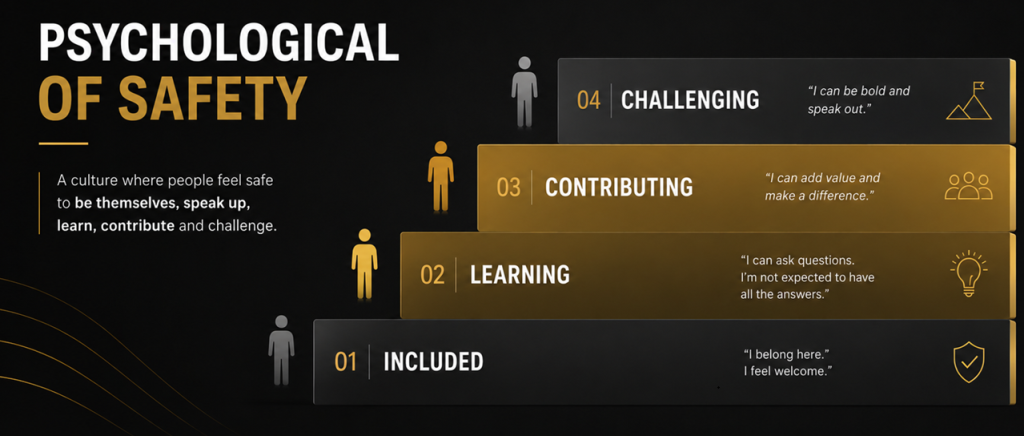
1. INCLUDED — “I belong here.”
Before people contribute, they need to believe they belong. They need to feel that they are accepted as part of the team and treated with dignity and respect. This doesn’t mean everybody needs to be friends.
It means:
I am recognised. I am respected. My presence matters.
When belonging is absent, people protect themselves. When belonging is present, people begin to participate.
2. LEARNING — “I can ask questions.”
Learning requires vulnerability.
The moment somebody says “I don’t know”, asks for help or admits a mistake, they expose themselves to judgement.
In psychologically unsafe environments, people quickly learn to hide uncertainty. They pretend to understand and remain quiet and cover up mistakes, and organisations lose valuable opportunities to learn.
A high-performance culture needs people who can say:
“I don’t know — yet.”
Because curiosity is more valuable than pretending to have all the answers.
3. CONTRIBUTING — “I can add value.”
People don’t want simply to belong to teams. They want to matter.
They want opportunities to use their knowledge, experience, perspective and strengths.
Strong leaders therefore don’t only ask:
“Did everyone understand?”
They also ask:
“What are we not seeing?”
That small shift invites contribution. And contribution creates ownership. When people believe their thinking matters, they become more willing to take responsibility for outcomes.
4. CHALLENGING — “I can speak up.”
This is where psychological safety becomes particularly important to high performance.
Can someone challenge the leader?
Can someone question the established way of doing things?
Can a junior employee identify a problem that senior leadership has missed?
Can teammates disagree without the disagreement becoming personal?
This is not rebellion. Done constructively, challenge protects performance. The employee who asks the uncomfortable question may be the person who prevents the expensive mistake. The team member who challenges an assumption may uncover the better strategy.
The leader who allows people to disagree may discover information they would otherwise never receive.
Silence Can Be Expensive
One of the greatest risks in organisations isn’t always conflict, it is silence.
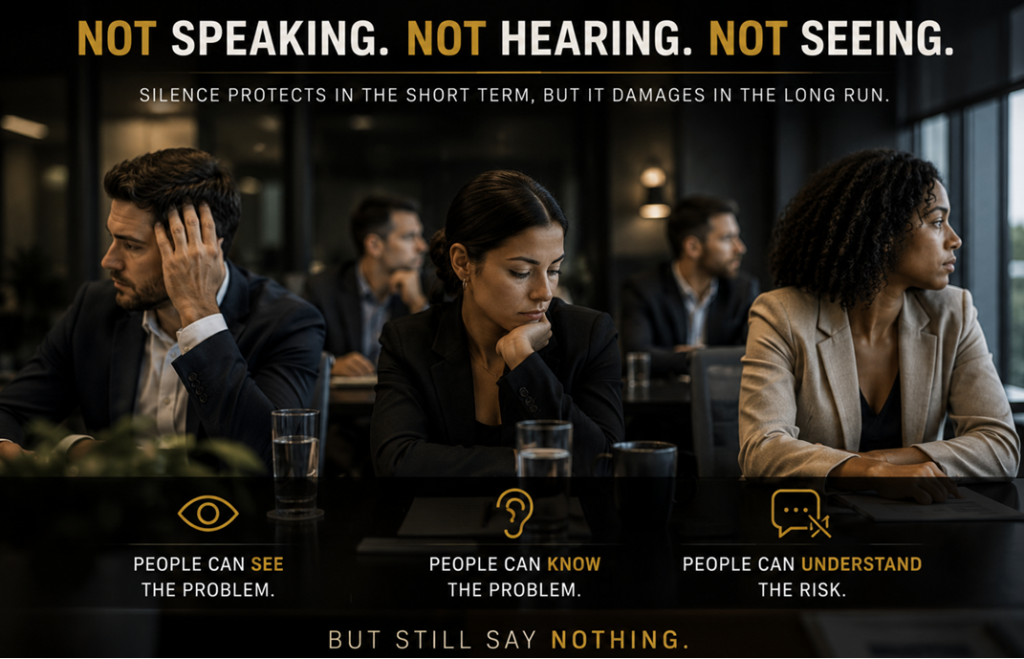
People see something. They think something. They know something. But they don’t say something.
Why? Because previous experience has taught them what happens when they do.
They might be embarrassed.
Dismissed. Labelled difficult. Interrupted. Ignored or punished.
Eventually, people adapt and the stop challenging. This silence can easily be mistaken for agreement.
Silence does not necessarily mean alignment. Sometimes it means people have decided that speaking isn’t worth the risk.
Psychological Safety Without Accountability Is Not High Performance
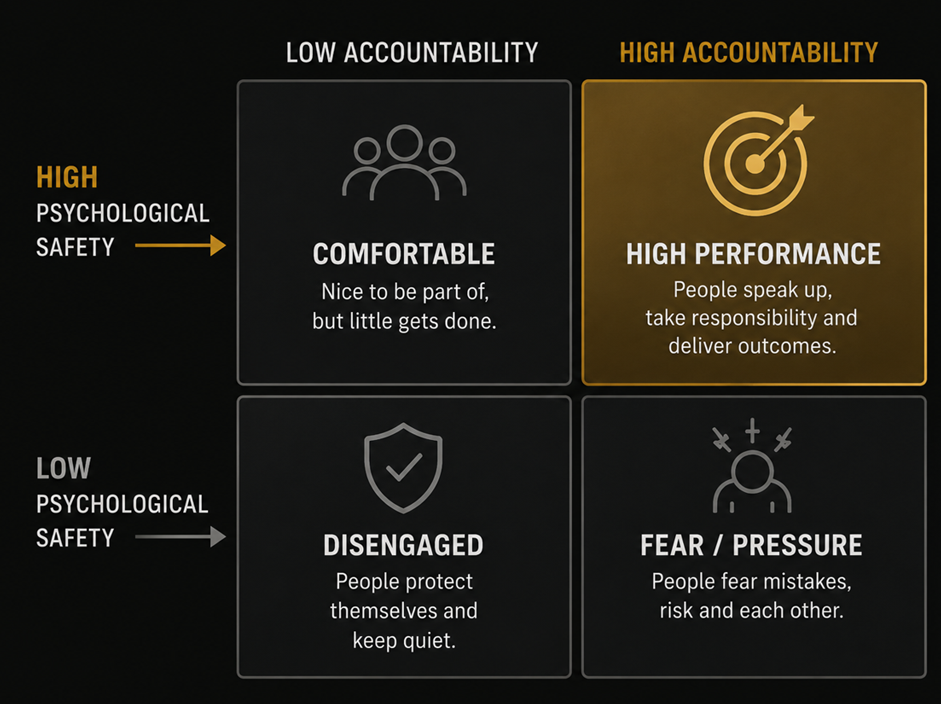
There is another side to this conversation. Psychological safety by itself is not enough. Teams also need standards e.g. Accountability, Ownership, Execution.
A team where everybody feels safe but nobody is held accountable will not necessarily perform.
Likewise, a team with enormous performance pressure but very little psychological safety may produce results temporarily, while eventually creating fear, silence, defensiveness or disengagement.
The objective is to build both:
HIGH PSYCHOLOGICAL SAFETY + HIGH ACCOUNTABILITY
That is a much more powerful performance environment.
People know:
I can speak openly.
And simultaneously:
I am responsible for what I bring to this team.
That combination changes culture.
Leaders Go First
You cannot put psychological safety on a company values poster and expect it to exist, because people learn whether an environment is safe by watching behaviour. Particularly the behaviour of leaders.
As a leader, watch what happens when somebody challenges you. Become aware of your facial expression when somebody delivers bad news. Notice whether you become defensive when receiving feedback. Notice whether you genuinely listen, or simply wait for the other person to finish. And pay particular attention to how you respond when someone makes a mistake.
Every interaction teaches people something.
Either:
“It is safe to speak.” or “Next time, keep quiet.”
Leadership behaviour determines which lesson becomes part of the culture.
Five Questions for Your Team
Rather than asking “Do we have psychological safety?”, have a more useful conversation.
Ask:
- Can people admit mistakes here without being humiliated?
- Can someone say “I don’t know” without losing credibility?
- Are different opinions genuinely welcomed?
- Can people challenge seniority respectfully?
- When someone speaks up, do we become curious or defensive?
The answers will tell you far more about your culture than a slogan on the wall.
From Safety to Performance
Psychological safety isn’t the end goal. Performance is.
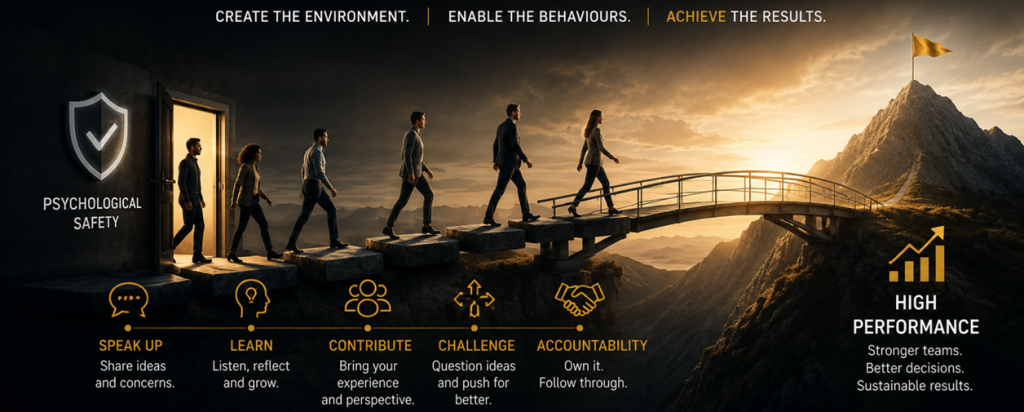
Psychological safety creates conditions where people can bring more of their thinking, experience, creativity and judgement into the room.
They can learn, contribute and challenge.
And when those behaviours are combined with clear standards, accountability and disciplined execution, teams become stronger.
So perhaps the question for leaders isn’t:
“Do my people feel comfortable?”
Ask instead:
“Have I created an environment where people feel safe enough to tell me what I need to hear, not simply what I want to hear?”
That is a very different leadership question. And the answer can have a significant impact on performance.
— Bennie Louw
High Performance Coach