Your Best Is Unreliable. Your Response Does Not Have to Be.
High performance is not about performing at your best every day
It is about knowing what to do when your best feels out of reach.
High performance is often presented as a permanent state.
Motivated. Focused. Confident. Disciplined. Productive. In control.
But that version of high performance is not only unrealistic, it can become harmful.
Nobody operates at their best every day.
There will be days when your energy is low, your thinking is clouded and your confidence is missing. Days when pressure exposes your doubts, conflict consumes your attention or change removes the certainty you depended on.
When everything is going well, performance can feel easy.
Confidence comes naturally when results are positive. Communication is easier when relationships are strong. Decisions appear clearer when there is little pressure and few consequences.
However, there will be moments when you know exactly what to do, and still struggle to do it. So perhaps we have been asking the wrong question.
The meeting becomes tense.
The strategy stops working.
A mistake is made.
Someone challenges your thinking.
The result you expected does not materialise.
The question is not:
“How can I always perform at my best?”
A better question is:
“How effectively can I respond when my best is difficult to access?”
Your Best Is Unreliable. Your Response Does Not Have to Be.

High performance is not revealed only in what you do when you feel confident. It is revealed in what you can still access when confidence disappears.
Can you remain curious when you feel criticised? Can you communicate clearly when emotion is rising? Can you make a considered decision while experiencing uncertainty? Can you recover from a mistake without allowing it to contaminate the next moment? Can you maintain your standards when motivation has left the room?
Your best performance may depend on favourable conditions. Your next response is still a choice.
Performance Is Human Before It Is Technical
Organisations invest heavily in strategy, systems, processes and technical competence. All of these matter, but ultimately, people must execute them, and people do not leave their humanity at the office door.
People bring emotions, fears, assumptions, habits, relationships, ambitions, insecurities and previous experiences into every decision and conversation.
Consider this:
A technically capable person can underperform when pressure changes how they think.
A talented team can become ineffective when trust deteriorates.
An experienced leader can make poor decisions when defensiveness replaces curiosity.
A sound strategy can fail when people do not feel safe enough to challenge it.
This is why sustainable performance requires more than knowing what to do. It requires the ability to manage yourself while doing what matters.
That may be the most overlooked performance skill of all.
The Dangerous Assumption That Potential Becomes Performance
Potential is attractive because it describes what might be possible.
But potential does not execute. Potential does not make the difficult call, have the uncomfortable conversation or recover after failure.
Knowing is not doing.
Talent is not consistency.
Intention is not behaviour.
Between what a person is capable of doing and what they consistently deliver lies the performance gap.
That gap is rarely caused by a complete lack of knowledge. More often, it is created by very human factors:
- Pressure that produces overthinking
- Fear of failure or judgement
- Poor emotional regulation
- Unclear expectations
- Conflict that remains unresolved
- Low trust
- Ineffective communication
- Resistance to change
- Loss of confidence
- Inconsistent standards and behaviour
This is where high-performance coaching has its greatest value.
Its purpose is not simply to provide more information to people who already know a great deal. It is to help them close the distance between what they know and what they can access when it matters.
To think more clearly.
To respond more deliberately.
To act more consistently.
Because performance is not measured by what you understand in a calm room. It is measured by what you can apply when the room is no longer calm.
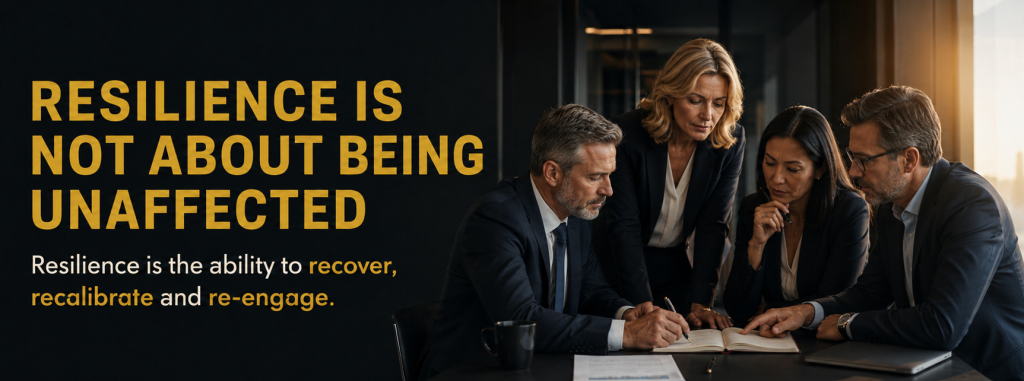
Resilience Is Not About Being Unaffected
We often admire people who appear unshaken by difficulty, but resilience is not emotional immunity.
Resilient people still experience disappointment, frustration, uncertainty and pressure. They can be hurt by criticism, unsettled by change and discouraged by failure. The difference is not that they are unaffected. The difference is what they do next.
Resilience is the ability to recover, recalibrate and re-engage.
Consider two people who make the same mistake.
One continues replaying it internally. The mistake becomes a judgement about their competence, their identity or their future. Their attention remains trapped in what has already happened.
The other acknowledges the mistake, takes responsibility, extracts the lesson and redirects attention towards the next decision.
The mistake is the same. The recovery is different.
And over time, that difference becomes performance. The resilient person does not necessarily fall less often. They become better at bouncing back.
Emotional Control Does Not Mean Emotional Suppression
There is another myth hidden inside many conversations about performance: that strong performers should keep emotion out of their decisions.
But emotions cannot simply be switched off. They influence what we notice, how we interpret situations, what we communicate and how quickly we react.
The goal is not to feel less. It is to become less controlled by what you feel.
Under pressure, three questions can create vital space:
What am I feeling?
What story am I telling myself about this situation?
What response will serve the situation best?
That pause may last only a few seconds, but it can change the direction of a conversation, a decision or an entire relationship.
Without awareness, emotion becomes reaction. With awareness, emotion becomes information. That is why emotional intelligence is not merely a “soft skill.”
A Group of High Performers Is Not Necessarily a High-Performing Team
Organisations often assume that recruiting talented people will automatically produce a strong team. It will not.
Individual talent may improve what each person can contribute, but teams depend on something more demanding: interdependence.
People must be able to listen, communicate, disagree, challenge, adapt and execute together. They must know when to lead, when to follow, when to speak and when to reconsider. This requires psychological safety—but psychological safety should not be confused with comfort.
A psychologically safe team is not one where everybody agrees or difficult conversations are avoided. It is one where people can raise concerns, admit uncertainty, question assumptions and acknowledge mistakes without unnecessary fear.
But safety without accountability can become complacency. And accountability without safety can produce silence. High-performing teams need both.
People must feel safe enough to speak honestly and responsible enough to act on what has been said. Strong teams do not eliminate tension. They learn how to use it productively.
They do not avoid difficult conversations. They become better at having them.
High Performance Is Built in Moments Most People Overlook
We tend to search for dramatic breakthroughs: the new strategy, the inspiring speech, the major transformation. But sustainable performance is usually built somewhere less visible.
In the conversation you stop avoiding. In the breath you take before responding. In the question you ask instead of making an assumption. In the decision to reset after a mistake.
In the standard you maintain when nobody is watching. In the feedback you choose to hear rather than defend against. In the willingness to adapt when your original plan no longer serves the situation.
These moments appear small. But repeated often enough, they become habits. Habits become behaviours and behaviours shape culture, and culture eventually appears in results.
High performance is not one extraordinary act, it is the accumulation of better responses.
Therefore “High Performance” is not about becoming someone who never doubts, struggles or loses momentum. It is about developing the awareness and mental skills to respond more effectively when those moments arrive.
For an individual, that may mean recovering more quickly after a setback.
For a leader, it may mean communicating with greater clarity under pressure.
For a team, it may mean creating enough trust to challenge one another honestly while remaining accountable to a shared standard.
For an organisation, it may mean building a culture capable of adapting without losing direction.
The context may change, but the principle remains:
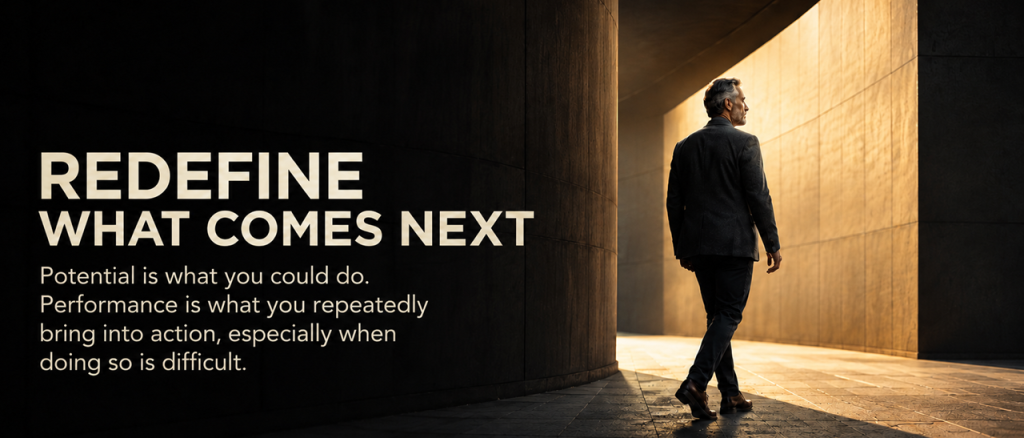
Potential is what you could do. Performance is what you repeatedly bring into action, especially when doing so is difficult.
Your best will not always be available. Your confidence will fluctuate. Your motivation will change. Pressure will sometimes disrupt your thinking. You will make mistakes.
The defining question is not whether those moments will happen. They will.
The defining question is: What will you do next?
Bennie Louw